Google’s cheap-and-easy VR platform added spatial-audio support to its SDK. That won’t make it an Oculus competitor, but it means Google is serious about VR.
The post Why Spatial Audio Is Such a Big Deal for Google Cardboard appeared first on WIRED.
Unrelated to the whiskey.

Google’s cheap-and-easy VR platform added spatial-audio support to its SDK. That won’t make it an Oculus competitor, but it means Google is serious about VR.
The post Why Spatial Audio Is Such a Big Deal for Google Cardboard appeared first on WIRED.
BitTorrent is a formidably popular tool. More than 170 million people regularly use the protocol to share files of all sizes, with the majority using desktop software clients such as uTorrent and popular crowd-pleaser qBitTorrent.
Nevertheless, alternatives are available. For many years more advanced BitTorrent users have been using so-called ‘seedboxes’. These remote servers run torrent clients that allow people to share content away from their home machines. With expanded bandwidth at their disposal, sharing large quantities of data via seedbox is a breeze.
But while seedboxes aren’t particularly difficult to operate or understand (most use a familiar interface), the majority are hidden behind a paywall. Although relatively inexpensive, this lack of exposure ensures that people interested in remote torrenting aren’t exposed to the experience.
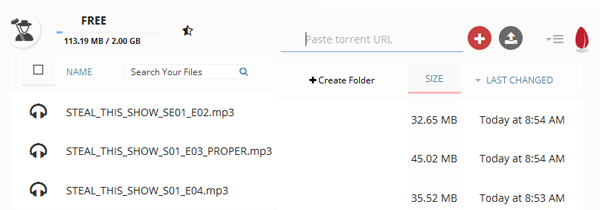
This is where Seedr steps in. Essentially a torrent client in the cloud, Seedr offers a free service to get people started and is ridiculously easy to operate.
On a basic level it’s as simple as making an account (just an email address is required) and either dragging or uploading a torrent to the service. Seedr is also fully magnet link capable and can even find a torrent when supplied with just the URL of a page.
Seedr then does all the downloading and sharing itself without a single byte hitting the user’s machine (great for those who want to get on with other things) and without any local IP addresses being exposed to a torrent swarm. This means the service helps to maintain user privacy too.

Once the download is complete (indicated by a basic progress bar) users can transfer the content to their own machine by hitting the download button while a right click reveals various other options.
In tests TF easily downloaded at a steady 25Mbps (even when limited by a VPN), meaning that a 1GB file took around five minutes to grab. Since downloads take place via HTTP, users can say goodbye to ISP throttling.
“Connections to the site are encrypted using SSL-256bit with strong ciphers, over HTTP/2 connections. All torrent traffic is done on our servers, and the identity of the users is never exposed. Security is up-to industry standards,” admin David informs TF.
But Seedr can do more.
“Once on the cloud you just see and manage your files – you can play them, stream them or download them if you want,” David says.
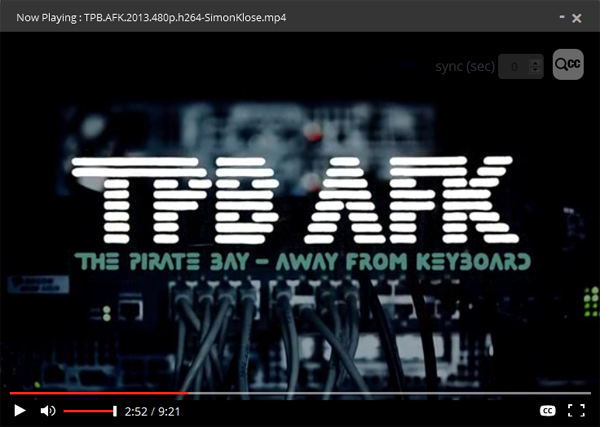
“There are many other small and cool features built into the system. For example, before you stream a movie you can seek for subtitles in any language and add them live. You can even sync them as you watch the movie.”

Since it’s browser-based, Seedr also works across devices – “anything but a sewing machine” according to David. Seedr also has a Chrome plug-in which enables users to add a download to Seedr in just two clicks – right-click on the link, left click on ‘Add to Seedr’. Done.
“The entire system was built to provide smooth streaming without wait-times for conversions ( even on phones ), and fast download speeds to home computers. All servers are 1000mbit or faster, and tuned for torrent, and file download traffic,” David says.
When attempting to stream to our Android test device there was an initial delay while the file converted but viewing was seamless after that. The black window that first appears needs to be tapped to reveal the playback controls.
Seedr collects anonymous data for bug fixes and the company says that all additional statistics are anonymized after 60 days. When users ask to have their accounts deleted, Seedr wipes their statistics along with the accounts within 48hrs.
Seedr offers a free tier and several packages for advanced users.
Free tier
– 2GB of free storage + more space for inviting friends
– Unlimited bandwidth, video playback support, high-speed downloads
– 1 parallel torrent download and 1:1 seeding ratio on public trackers
Premium
– 100GB-250GB of storage (1TB packages coming soon)
– Unlimited parallel downloads, HD streaming and API access
– 1:1 seeding ratio on public trackers
– Private trackers support with up to 5:1 or 5 days seeding ratio
In respect of copyright action, if Seedr receives a DMCA notice the company removes the offending torrent and advises the user. That is the end of the matter.
Overall
Easier to operate than uTorrent (by a long way), Seedr’s beauty lies in its simplicity. It’s hard to imagine anyone other than complete novices needing to revert to the site’s tutorial. However, those that do won’t be disappointed as it reveals ways to integrate the service into Kodi/XBMC.
Free tier aside (which is a steal) it’s not cheap at $9.95 per month (two months free on annual rates) so the service might benefit from having a more limited lower-tier premium package around the $6 to $7 mark.
Those who obsess over the minutiae of their torrenting might prefer a full-blown seedbox experience, but Seedr knows its target audience and appears to serve them well.
Seedr can be tested here for free.
Source: TF, for the latest info on copyright, file-sharing, torrent sites and ANONYMOUS VPN services.
Source: TorrentFreak

With the launch of legal streaming services such as Netflix, movie and TV fans have less reason to turn to pirate sites. At the same time, however, these legal options present new copyright-related problems and threats.
Traditionally the movie industry has relied on geographical licensing deals through which movie and TV-show rights are sold to separate parties in various countries.
Ten years ago this model wasn’t causing any issues. But now that the Internet has made entertainment more instant and global, the public is beginning to complain.
Why do Netflix users in Andorra, Bolivia and the Cook Islands have access to Better Call Saul, while Americans don’t? Similarly, why can Danish people watch American Sniper while it’s pretty much unavailable in the rest of the world?
Most Netflix users don’t understand.
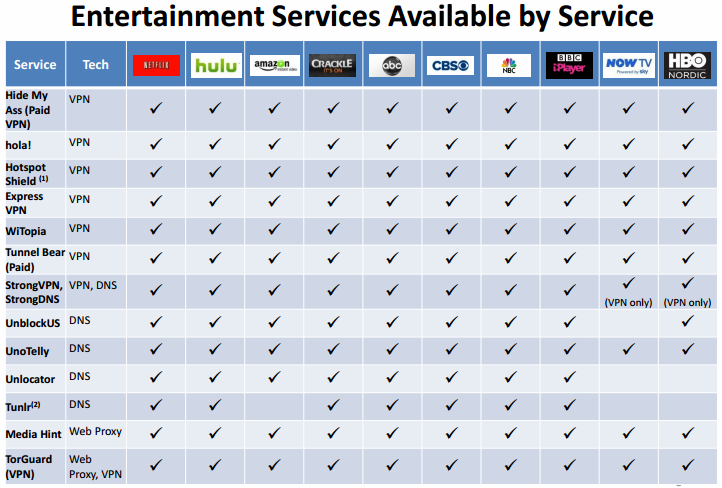
This frustration is driving people to circumvent geographical restrictions by using VPNs and proxy services. With help from handy tools such as the “unofficial Netflix online Global Search” every Netflix subscriber can easily access these hidden treasures.
There are even specialized applications that do the same, giving people a browsable library of all Netflix titles with built-in proxies.
unofficial Netflix online Global Search
Netflix’s announcement to ramp up its crackdown on VPN and proxy pirates comes a week after Netflix expanded its reach by more than 130 countries. This obviously isn’t a coincidence, as the two are directly linked.
While Netflix has always been contractually obliged to take measures against unblocking efforts, its near worldwide expansion makes it a higher priority.
Targeting VPN and proxy “pirates” has been high on the Hollywood agenda for several years already. For example, in 2014 Sony Pictures conducted research to identify the IP-ranges of various VPNs and proxies.
It turned out that most were not, and these results were shared with Netflix and other streaming services so they could take action and expand their blocklists where needed.
The question is, however, whether this repressive approach will be effective.
In fact, the announced measures may cause some people to give up their subscriptions and return to their old piracy habits, which should worry both Netflix and the movie studios. The true solution lies somewhere else.
While it’s easier said than done the film industry should move away from its complicated licensing schemes and windowed releases, much like the music industry has. This is a change Netflix backs according to recent statements.
According to Netflix the ‘VPN pirates’ are willing to pay, they just can’t get what they want through their local Netflix.
Speaking out on the controversial VPN use, Netflix CEO Reed Hastings said that the problem can be fixed if the industry starts to offer the same content globally, without artificial barriers.
“The basic solution is for Netflix to get global and have its content be the same all around the world so there’s no incentive to [use a VPN]. Then we can work on the more important part which is piracy,” Hastings said.
For now Netflix can do little else than comply with the pressure from Hollywood, but as soon as they roll out broad VPN blockades it’s going to cause problems.
Many people use VPN services to protect their privacy, not to fool Netflix, and when they are locked out of their accounts there’s bound to be some uproar. At the same time it will trigger a new cat-and-mouse game where “unblocking” services will try to bypass Netflix’s blocks against them, and so on.
It’s hard to see any winners in this game, except perhaps from the Hollywood insiders who lack a long-term vision.
Source: TF, for the latest info on copyright, file-sharing, torrent sites and ANONYMOUS VPN services.
Source: TorrentFreak
People all around the world are unable to access the most visited torrent site since a few hours.
The site is suffering from a Distributed Denial of Service (DDoS) attack and has been hard to reach.
As a result, all official KAT proxies are suffering downtime as well.
The KAT team confirmed to TorrentFreak that attack is targeted at the site’s DNS servers and they are doing their best to solve the issue.
The DDoS attack is not new and also caused a brief outage yesterday and earlier in the week. The site has managed to come back a few times, but it appears that the problems still persist.
KAT down
Source: TF, for the latest info on copyright, file-sharing, torrent sites and ANONYMOUS VPN services.
Source: TorrentFreak

Space photos of the week, January 10–16.
The post Space Photos of the Week: A Green Pea Galaxy Gets Groovin’ appeared first on WIRED.

Netflix says it will soon begin to block users trying to access its content via VPN. That will be difficult. It’s also ultimately beside the point.
The post Netflix’s VPN Ban Isn’t Good for Anyone—Especially Netflix appeared first on WIRED.

I have a confession to make: I never watched “Sesame Street.”
The post Why I’m Watching Sesame Street for the First Time Tonight appeared first on WIRED.

In this week’s episode of the ‘Geek’s Guide to the Galaxy,’ writer Joseph Laycock discusses his new book on the moral panic around role playing games.
The post Dungeons & Dragons Is a Lot Like Religion appeared first on WIRED.

If you’re headed to Detroit and don’t have all day to wander the show floor, here are the five coolest cars you’ve got to see.
The post The Coolest Cars at This Year’s Detroit Auto Show appeared first on WIRED.
The Institute for Development of the Internet is an entity created to promote discussion between representatives of the Russian government and Internet-focused companies. Typically the platform is used to iron out differences on contentious issues.
In February 2015 Herman Klimenko became chairman of the Institute but last December was called upon by Russian president Vladimir Putin to become his personal adviser on the development of the Internet. After consulting with his family on what he described as a “big decision”, the 49-year-old accepted Putin’s offer.
This week Putin signed a decree that officially enlisted Klimenko as his
Presidential Adviser on the Internet. It’s a big position for the expert who now has the ear of one of the world’s most powerful men on all Internet related matters from trade through to education and finance.
Not unexpectedly the Internet piracy controversy also falls within Klimenko’s remit and it didn’t take long for the newly-crowned heavyweight to weigh in with his opinions. Surprisingly, those opinions include pouring cold water on aggressive measures for dealing with piracy, website blockades for example.
Speaking with local TV channel Russia 24, Klimenko said that when copyright holders demanded that ‘pirate’ websites should be blocked on a permanent basis, none considered whether it would actually be possible.
“When rights holders pressed for measures such as eternal blocking, I think they did not consider that it would be unfeasible for technical reasons,” he said.
“If a method to carry out such blocking did exist, it’s another question whether it is necessary to use it or not.”
But while website blocking is a controversial issue that even some copyright holders don’t believe in, it’s likely that a few eyebrows would’ve been raised at Klimenko’s suggestion that aggressive anti-piracy measures should be aligned with the state of the economy.
While acknowledging that creators should be able to get a return on their products, Putin’s adviser said now might not be the right time to send in the heavies to “terrorize” the public on the matter.
“There is always the relevance of this issue,” he said.
“In fact, consumption of copyright content increases with economic growth, and when the situation is very serious, I think people do not have to unnecessarily terrorize these issues,” said the presidential adviser.
Turning to copyright holders, Klimenko said that he believes they should consider the economic conditions before demanding more action.
“Pushing hard now on this topic, I think, is not worth it. When the economy improves, you should return to this issue,” he said.
But with relations with the West still strained over Ukraine and all the financial pressures that brings, how long will copyright holders have to wait? According to Deputy Minister of Economic Development Oleg Fomichev, perhaps some time yet.
“The current economic situation is definitely not that good. The Russian economy is not in the best shape, but it is not as bad as it was expected one year ago,” he revealed this week.
“We are now relatively optimistic about economic dynamics for the next several months and the next year because we see from June, and more positively from September, we see an upturn in the Russian economy.”
So everyone will stop complaining about piracy until the fall then? Not a chance…..
Source: TF, for the latest info on copyright, file-sharing, torrent sites and ANONYMOUS VPN services.
Source: TorrentFreak