Rightscorp Plans to Hijack Pirates’ Browsers Until a Fine is Paid

hijackEarlier this week, anti-piracy outfit Rightscorp published its results for 2015. They make for dismal reading, with the company recording a net loss of $3.43m, up from the $2.85m net loss recorded in 2014.

The company has a number of problems. First and foremost it has too few clients and somehow needs to expand the catalog of copyrights under its protection. With a wider spread and greater volume it could do better, but that’s only part of the problem.

Internet service providers in the United States aren’t generally fans of copyright trolls like Rightscorp. They prey on valuable customers who often incorrectly conclude that their provider has been spying on them. Of course the sting in the tail is the compensation that Rightscorp demands, all conveniently delivered to the Internet subscriber by their ISP.

In its filing this week Rightscorp blamed falling revenues on a reluctance by ISPs to pass on these automated fines. Nevertheless, the company isn’t giving up on improved cooperation with service providers since it has a plan that could streamline its business and more or less force users to pay up.

Rightscorp says this could be achieved via a “next generation technology” its developing called Scalable Copyright, which will shift warnings and settlement demands away from easily ignored emails and towards an altogether more aggressive delivery method.

“In the Scalable Copyright system, subscribers receive each [settlement] notice directly in their browser,” the company reports.

“Single notices can be read and bypassed similar to the way a software license agreement works [but] once the internet account receives a certain number of notices over a certain time period, the screen cannot be bypassed until the settlement payment is received.”

The idea of locking browsers in response to infringement allegations is nothing new. Users of some ISPs in the United States already receive these warnings if too many complaints are made against their account. However, to date no company has asked for money to have these locks removed and the idea of ‘wheel clamping’ a browser is hardly an attractive one, especially based on the allegations of a third-party organization.

Still, Rightscorp seems confident that it can persuade ISPs to come along for the ride.

“Its implementation will require the agreement of the ISPs. We have had discussions with multiple ISPs about implementing Scalable Copyright, and intend to intensify those efforts. ISPs have the technology to display our notices in subscribers’ browsers in this manner,” the company notes.

While ISPs do indeed have the ability to hold their customers to ransom on Rightscorp’s behalf, the big question is why they would choose to do so. On the surface there seems no benefit to ISPs whatsoever, since all it will do is annoy those who pay the bills. But Rightscorp sees things somewhat differently and says that the system will actually be both cheap and beneficial to ISPs.

“We provide the data at no charge to the ISPs. With Scalable Copyright, ISPs will be able to greatly reduce their third-party liability and the music and home video industries will be able to return to growth along with the internet advertising and broadband subscriber industries,” the company explains.

That third-party liability is the requirement under the DMCA for service providers to terminate repeat infringers or face the prospect of losing their safe harbor protections.

“U.S. ISPs have a safe harbor that is conditional on terminating repeat copyright infringers. Rightscorp has the technology to identify these repeat infringers. ISPs either need to work with copyright holders to reduce repeat infringers identified by Rightscorp or face significant liability,” the company warns.

As the recent case between BMG and Cox Communications illustrates, ISPs do need to be cautious over the issue of repeat infringers and they must have policies in place to deal with them. However, the notion that a browser-lock system like this one needs to be deployed is unlikely to be on the agenda of many ISPs, especially considering Rightscorp’s track record.

While the MPAA/RIAA Copyright Alerts program limits the numbers of warnings that can be sent to single subscriber in order to avoid labeling them as repeat infringers too quickly, Rightscorp is on record as sending 112 notices to a single Comcast user in less than 48 hours over the sharing of a single torrent.

But despite all the rhetoric, these ambitious plans to hijack browsers to generate revenue will require ISPs to co-operate more with Rightscorp, not less, so the current downward trend in forwarding the company’s notices is hardly encouraging.

Source: TF, for the latest info on copyright, file-sharing, torrent sites and ANONYMOUS VPN services.


Source: TorrentFreak

Music Industry: DMCA Copyright Law is Obsolete and Harmful

cassetteSigned into law by President Bill Clinton in 1998, the Digital Millenium Copyright Act (DMCA) aimed to ready copyright law for the digital age.

The law introduced a safe harbor for Internet services, meaning that they can’t be held liable for their pirating users as long as they properly process takedown notices and deal with repeat infringers.

However, in recent years copyright holders, Internet services and the public in general have signaled various shortcomings. On the one hand, rightsholders believe that the law doesn’t do enough to protect creators, while the opposing side warns of increased censorship and abuse.

To hear the growing concerns from all sides the U.S. Copyright Office launched a public consultation in order to evaluate the impact and effectiveness of the DMCA’s safe harbor provisions.

A few hours ago a broad coalition of 400 artists and music groups, including the RIAA, Music Publishers Association and A2IM submitted their response. The 70-page brief provides a comprehensive overview of what the music industry sees as the DMCA shortcomings while calling for significant reform.

“The Music Community’s list of frustrations with the DMCA is long,” the groups write, adding that “a law that might have made sense in 1998 is now not only obsolete but actually harmful.”

The music industry’s comments focus heavily on search engines, Google in particular. In recent years music companies have sent hundreds of millions of takedown notices to Google, but despite these efforts, copyright infringing material is still topping many search results.

“The notice-and-takedown system has proved an ineffective tool for the volume of unauthorized digital music available, something akin to bailing out an ocean with a teaspoon,” they write.

“Copyright owners should not be required to engage in the endless game of sending repeat takedown notices to protect their works, simply because another or the
same infringement of the initially noticed work appears at a marginally different URL than the first time.”

The music groups are calling for advanced technologies and processes to ensure that infringing content doesn’t reappear elsewhere once it’s removed, a so-called “notice and stay down” approach.

This includes audio fingerprinting technologies, hash-matching technologies, meta-data correlations and the removal of links that point to content which has been taken down already.

“The current standard of ‘URL by URL’ takedown does not make sense in a world where there is an infinite supply of URLs,” the groups add.

Another problem with the DMCA, according to the music companies, is that the safe harbor provision also protects sites that are clearly profiting from copyright infringement.

Describing it as a “get out of jail free” card for many dubious sites, RIAA and the others demand change.

“At its worst, the DMCA safe harbors have become a business plan for profiting off of stolen content; at best, the system is a de facto government subsidy enriching some digital services at the expense of creators. This almost 20 year-old, 20th Century law should be updated,” they write.

The music industry groups note that these and other issues have turned the DMCA law into a “dysfunctional relic,” and are calling on Congress to take action and come up with a copyright law that better protects their interests.

The anti-DMCA comments submitted to the U.S. Government are the strongest we’ve seen thus far, but more responses are expected to be published after the deadline passes today.

Where most copyright holders call for stricter anti-piracy measures, many Internet services and activists are expected to focus on the increase on DMCA abuse and censorship.

Earlier this week a Google-funded report revealed that close to 30% of all DMCA requests it receives are “questionable” and the EFF previously called on the public to share their DMCA horror stories.

In addition, Fight for the Future just launched a campaign page, helping the public to inform the Copyright Office that DMCA abuses should be stopped. The campaign generated over 50,000 comments in a day, ‘crashing’ the Government’s website.

Source: TF, for the latest info on copyright, file-sharing, torrent sites and ANONYMOUS VPN services.


Source: TorrentFreak

50,000 People Protest DMCA Abuse, “Crash” Government Server

copyright-brandedThe U.S. Government is currently running a public consultation to evaluate the effectiveness of the DMCA’s Safe Harbor provisions, including issues around automated takedown requests and potential abuse.

The deadline for comments expires tonight and despite being announced three months ago, it only generated a few dozen responses until yesterday.

That quickly changed when Fight for the Future (FFTF) and the popular YouTube channel Channel Awesome got involved. They launched a campaign urging the public to speak out against DMCA takedown abuse and censorship yesterday afternoon, generating an overwhelming response.

By this morning the campaign video had been viewed 170,000 times, and the buzz triggered 50,000 comments to the Copyright Office, submitted through the form hosted at TakedownAbuse.org.

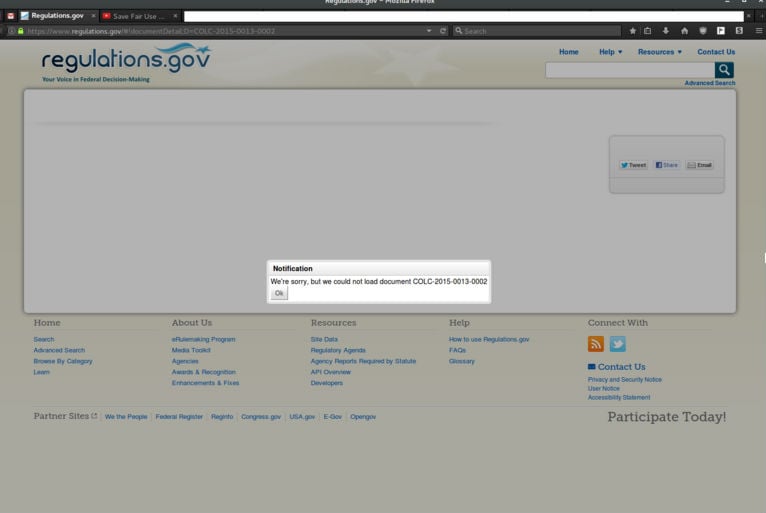
As a result the official Regulations.gov site reportedly became unresponsive for a while.

“The flood of new submissions over the last several hours appears to have repeatedly crashed the website that the government set up to receive feedback,” FFTF writes.

Issues at Regulations.gov

regul

Due to the massive response, many submitted comments are now waiting in a queue, prompting the activist group to call for an extension of the consultation’s deadline.

“The DMCA affects all Internet users and they should have an opportunity to express their concerns with the ways content is censored from the Internet, causing damage to free speech that can’t be undone,” FFTF co-founder Tiffiniy Cheng says.

“The Copyright Office has a responsibility to make sure these voices are heard. They need to extend the deadline and make sure their website stays up and can receive comments the entire time.”

The comments the campaign site allows people to send to the Copyright Office urge Congress to impose statutory damages for rightholders that abuse the DMCA takedown process or fail to take fair use into account. In addition, they call for a discouragement of automated takedown systems, including YouTube’s Content-ID system.

Given the high number of submissions generated by the campaign, it will be interesting to see what conclusions the Copyright Office will draw after the review is completed.

Channel Awesome’s campaign video

Source: TF, for the latest info on copyright, file-sharing, torrent sites and ANONYMOUS VPN services.


Source: TorrentFreak

Reddit Working On a Copyright Takedown Transparency Report

For those interested in the pressures placed on large sites by governments, law enforcement, litigious third parties and copyright holders, transparency reports are wonderful things.

Published on an annual or even daily basis in the case of Google, these reports disclose information to the public relating to court-ordered requests for user data through to the removal of allegedly copyright infringing content.

Here at TF we’re generally confronted with the latter, with Google’s Transparency Report providing a goldmine of information that would ordinarily be kept out of the public eye. In fact, it’s quite possible that the publication of this report will help to shape future legislation, with both Google and copyright holders currently relying on the data to lobby for change and/or the status quo.

With the importance of transparency reports established, it’s always nice to see new companies jumping on board. Following Google’s first publication in 2010, Twitter followed in 2012 and they’re now joined by a multitude of companies from Microsoft and Facebook to Cloudflare.

In early 2015, Reddit produced its first report covering the previous 12 months which revealed that the site rejects 62% of all copyright complaints. However, other than that the report was light on copyright data, something the site is now working to address.

Noting that in 2015 the site received a large number of requests to remove content under the DMCA, Reddit’s operators say they’re now working on tools to provide more transparency.

“To cope with Reddit’s rate of growth in 2015 and the subsequent spike in the number of takedown requests received, we have dedicated significant time and resources to build internal tools to allow us to accurately track the number and types of requests that we are receiving,” the site reveals in its latest report.

“This is an ongoing project, which we hope to be able to refine, so that we can be transparent with our users, on how much content we takedown on the site. For perspective, from January 1, 2016 to February 29, 2016, we received approximately 190 requests to remove content under the DMCA. 5% of these requests required us to remove content from the site.”

How sites respond to takedown notices under the DMCA is of huge interest at the moment, with copyright holders keen to tighten up the legislation and those on the receiving end often torn between taking content down to avoid liability while considering crucial issues such as fair use. For its part, Reddit likes to do things properly.

“Each DMCA takedown notice is reviewed carefully and, in circumstances where content is actually hosted on our servers, we assess whether the existence of the content on Reddit can fall under an exception, such as ‘fair use’ of the copyrighted material,” the site explains.

“If we believe that the existence of the content can be defended or falls under an exception under copyright law, then we may request further information from the requesting party that will assist us in our review.”

More transparency is always a good thing as it helps to understand the dilemmas faced by those on all sides of the copyright debate. Reddit’s report will be a welcome addition.

“We are hopeful that our newly implemented method of tracking requests will put us in a position where we can provide you with confirmation of more accurate information regarding DMCA requests that are received throughout 2016 and how we responded to them,” the site concludes.

Update: It appears that Reddit’s warrant canary has been removed from this year’s transparency report which is causing speculation that the site is currently the subject of a national security letter.

“I’ve been advised not to say anything one way or the other,” says Reddit admin ‘spez’. “Even with the canaries, we’re treading a fine line.”

More discussion here

Source: TF, for the latest info on copyright, file-sharing, torrent sites and ANONYMOUS VPN services.


Source: TorrentFreak