
Harry Potter Publisher Goes on a Bizarre Anti-Piracy Rampage

harryThe issue of removing infringing content and links from the Internet is perhaps the hottest topic in copyright today, with a U.S. Copyright Office consultation generating opinions from stakeholders of all kinds.

The aim of the consultation is to measure whether the DMCA is fit for purpose or whether it needs to be tweaked to handle an Internet that has developed massively in the past twenty years. Generally speaking, copyright holders want the DMCA tightened up dramatically, with many calling for regime that would see pirate content being taken down and remaining down forever.

While in some respects its easy to have sympathy with that stance, copyright holders can’t be trusted to get it right all of the time. In fact, sometimes mistakes are made that are so absurd that they deserve highlighting in public.

HarperCollins, Random House, Simon and Schuster, Reed Elsevier, Scholastic and J.K.Rowling’s Pottermore are some of the most recognizable publishers in the world and like many in their position, all have a bit of a piracy problem. Every year through their anti-piracy partners they send millions of takedown notices directly to ‘pirate’ sites and to Google, who are expected to take down content on demand.

It’s fortunate that Google does not do so without due consideration. It’s also fortunate that there’s no takedown-and-staydown system in place.

Pottermore is a digital publishing and e-commerce platform from J.K. Rowling, the author of the world famous Harry Potter series. Through anti-piracy company Digimarc the company has sent more than 260,000 takedown notices to Google with the majority raising few alarm bells. Recently, however, something appears to have gone terribly wrong.

On March 8, Pottermore sent a notice to Google complaining that several sites were infringing on the rights of, among other things, Harry Potter and the Order of the Phoenix. Inexplicably, one of those complaints was leveled at J.K. Rowling’s own page on Wikipedia. The same mistake was made again on April 1.
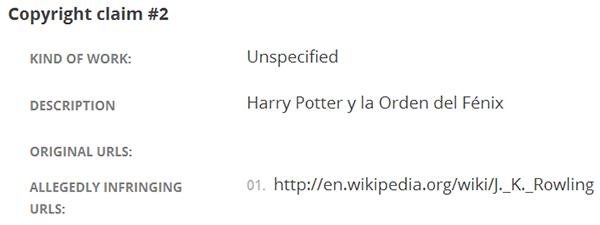
potter1

Fortunately Google refused to remove the page but Pottermore were undeterred and later that day sent an even worse notice that targeted a further 20 Wikipedia pages.

In addition to targeting several pages dedicated to Harry Potter movies, soundtracks and videos games, the notice casts its net far and wide with demands to remove pages detailing ancient Egyptian literature, ethnic groups in Central America, the attacks of 9-11, IEC standards, U.S. soldier Joshua Casteel and the NATO phonetic alphabet.
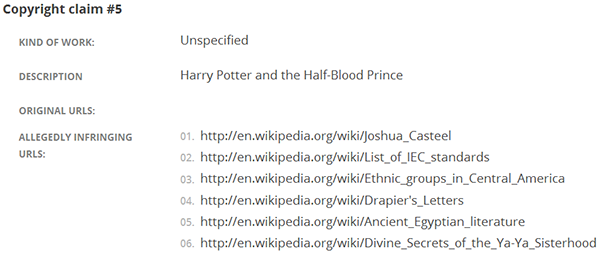
potter2

But Pottermore aren’t the only ones contributing to this Wikipedia mess. In early March, HarperCollins sent notices to Google, again through Digimarc, aiming to protect its own content. Instead, however, the company put its name to a whole bunch of bogus takedowns.

Instead of protecting the book ‘The Longest Trip Home’, the publisher tried to takedown the Wikipedia pages for Beverley Hills 90210 and Silver Spring, Maryland. Shortly after another notice targeted Wikipedia pages on the topics of BitTorrent, Carson in California, and the identity of Mexican Americans.
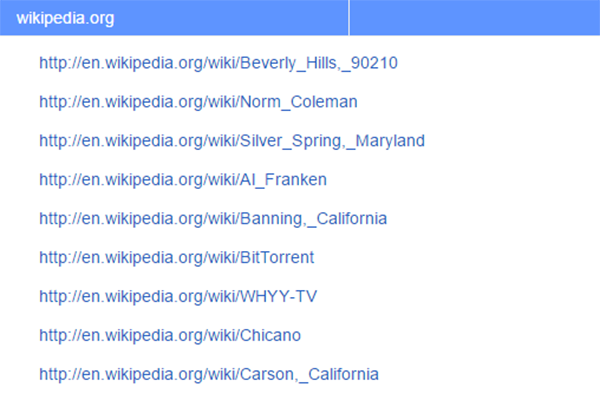
harper1

We won’t detail every single request here but there are dozen of bogus claims against Wikipedia, all of which Google (fortunately) denied. Those interested can find them in Google’s report where dozens are listed as rejected..

Simon and Schuster don’t have much to brag about either. In an effort to protect a handful of books they also targeted Wikipedia on dozens of occasions. With no apparent checking mechanism in place we can see the kinds of abuses shown below.

Poor Janice Galloway is actually a Simon and Schuster author, yet they want her Wikipedia page removed. Heaven knows what copyright crimes the speed limits in Romania have committed.
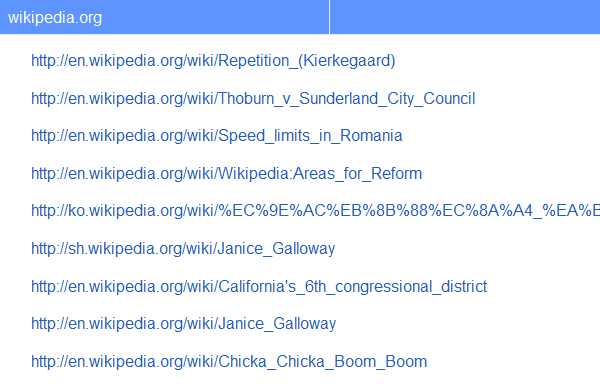
sas1

Finally, a couple of choice takedowns, the first from Reed Elsevier. In an effort to protect Mandell, Douglas, and Bennett’s Principles and Practice of Infectious Diseases, the publisher attempted to takedown the Wikipedia page detailing Mega, the file-hosting site previously associated with Kim Dotcom.

And Random House must have a real grudge against deceased U.S. writer Gore Vidal. On several occasions the company ordered Google to remove his Wikipedia page and links to his books, despite them being his publisher.

Takedown and staydown? Perhaps copyright holders want to think this through…..

The full catalog of Wikipedia takedown abuses can be found here.

Source: TF, for the latest info on copyright, file-sharing, torrent sites and ANONYMOUS VPN services.


Source: TorrentFreak

Paramount: We Own The Klingon Language

klingonEarlier this year Paramount Pictures and CBS Studios filed a lawsuit against the makers of the Star Trek inspired fan film, accusing them of copyright infringement.

The dispute centers around the well-received short film Star Trek: Prelude to Axanar and the planned follow-up feature film Anaxar.

Among other things, the Star Trek rightsholders claim ownership over various Star Trek related settings, characters, species, clothing, colors, shapes, words, short phrases and even the Klingon language.

Axanar productions and Alec Peters, the makers of the fan-spinoff, responded to several of the allegations last month arguing that several of the allegedly “infringing elements” are not protected by copyright at all.

They argued that the Klingon language is not copyrightable because it’s not more than an idea or a system. They therefore asked the court to dismiss or strike the copyright claims in question.

However, Paramount and CBS disagree (bIlughbe’*). In their reply the rightsholders call the argument absurd and among other things, they point out that the language system is not very useful if there are no real Klingons to communicate with.

“This argument is absurd, since a language is only useful if it can be used to communicate with people, and there are no Klingons with whom to communicate,” they write (full filing: pdf).

“Defendants’ use of the Klingon language in their works is simply further evidence of their infringement of Plaintiffs’ characters, since speaking this fictitious language is an aspect of their characters.”

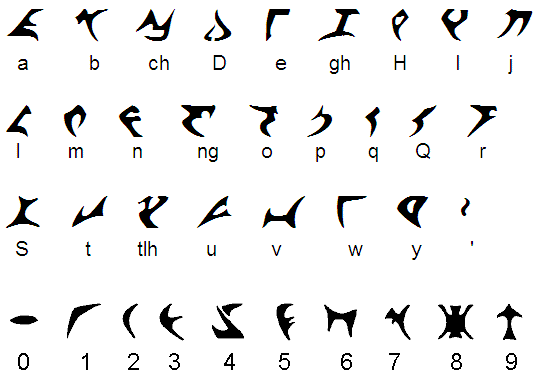
Klingon alphabet (image: wiki)

klingonalpha

In any case, the court should not rule on the matter prematurely, the rightsholders note. The question to what degree various elements are copyright infringing should be decided in future hearings where the issues can be properly addressed.

The same applies to other elements, including spaceships. Axanar productions argues that these general concepts can’t be copyrighted, but Paramount and CBS point out that their specific expression of Klingon warships is.

Klingon ships

klingonships

“Plaintiffs have not merely alleged that the general concepts of a ‘spaceship’ or a ‘spacedock’ have been appropriated – the Complaint’s allegations show that Defendants have misappropriated the expression of these concepts,” the movie studios inform the court.

Citing relevant case law, they argue that Star Trek starships deserve the same protection as the Batmobile.

“Even assuming that Defendants are properly dissecting the elements of the Star Trek Copyrighted Works (and they are not), courts have held that vehicles like the Batmobile are copyrightable as characters, and therefore, specific Star Trek starships are also copyrightable.”

Summing up, Paramount and CBS argue that the infringing status of the various elements should be considered in substantial similarity analysis during the lawsuit. They therefore ask the court to deny Axanar’s motion to dismiss or strike their claims.

*bIlughbe’ means you are wrong, in Klingon

Source: TF, for the latest info on copyright, file-sharing, torrent sites and ANONYMOUS VPN services.


Source: TorrentFreak

Anti-Piracy Firm Wants ISPs to Pay for Pirating Subscribers

cegtekintOver the past weeks dozens of companies and organizations have shared their concerns regarding the current state of the DMCA copyright law.

The responses are part of a consultation launched by the U.S. Copyright Office. Most focus on the effectiveness of the notice and takedown model, and the response of anti-piracy firm CEG TEK International zooms in on how ISPs handle these notices.

The company is well-known for its collaboration with adult video companies, for which it targets individual Internet subscribers with settlement requests. These requests are sent through DMCA notifications, commonly demanding a few hundred dollars.

Some ISPs forward these requests but most large providers have chosen not to do so. This is problematic for CEG TEK as it hurts their business model.

“The problem is the roadblocks to enforcement of copyrights that are put up by online service providers to protect their relationships with their infringing customers,” CEG TEK’s attorney writes.

The anti-piracy outfit points out that they, and others, can easily track the IP-addresses of pirates. But, without cooperation from ISPs this information isn’t very helpful.

“Unfortunately, the ISPs, who rake in millions, and probably billions, of dollars from their infringing customers, do not voluntarily disclose the infringer’s identities,” CEG TEK notes.

Under the DMCA, Internet providers are not required to forward all notices of claimed copyright infringement. CEG TEK recommends changing towards Canada’s model instead, where subscribers must be notified.

“Canada’s ISPs forward such notices at no charge to copyright owners. Setting up forwarding systems is relatively easy and inexpensive, and is similar to ISPs normal bill-forwarding systems,” the company notes .

In this case, CEG TEK would like U.S. ISPs to forward their “bills,” but there is more.

In addition to a forwarding requirement the anti-piracy firm also suggests the introduction of statutory damages for Internet providers, requiring them to pay $30 each time a subscriber doesn’t stop sharing pirated content.

“By statute require ISPs to pay copyright owners $30 for each notice of claimed infringement sent with respect to an Internet account having repeat infringements,” the suggestion reads.

“Do this, and ISPs would actually enforce their own Terms of Use that currently give lip service to the concept that customers are forbidden from engaging in copyright infringement,” CEG TEK adds between brackets.

The submission is written by CEG TEK attorney Ira Siegel, who also represented several rightsholders in various lawsuits against “John Doe” BitTorrent users, as copyright troll watcher FCT points out.

Siegel’s “trolling” connection is relevant as he also proposes several changes to the DMCA in order to make it easier to identify pirates through courts. Among other things, CEG TEK suggests allowing mass-BitTorrent lawsuits, in which tens of thousands of IP-addresses can be grouped (joined) in one complaint.

Such a change would make it cheaper to uncover the identity of alleged infringers, as rightsholders would only have to pay a single filing fee.

The proposals put forward by CEG TEK are among the most far-reaching we’ve seen thus far. They also directly oppose comments made by the U.S. broadband association USTelecom, which asked the copyright office to stop “abusive” notices that include settlement demands.

Source: TF, for the latest info on copyright, file-sharing, torrent sites and ANONYMOUS VPN services.


Source: TorrentFreak

Piracy Fails to Prevent Another Box Office Record

mpaa-logoMPAA chairman and CEO Chris Dodd made his fifth keynote speech at CinemaCon yesterday, pouring buckets of cold water on the idea that piracy is somehow threatening the very existence of the movie industry.

“I’m proud to say that the state of our industry has never been stronger,” the former U.S. senator said.

Indeed. Yesterday the MPAA released its latest Theatrical Market Statistics Report which revealed that global box office revenues reached $38.3 billion in 2015, up 5% on 2014’s total. The United States and Canada turned in $11.1 billion with international box office revenues hitting $27.2 billion.

“To paraphrase Mark Twain, the death of the movies has been greatly exaggerated,” Dodd said.

Exaggeration was the name of the game four years ago during the SOPA debate, when one might have been forgiven for believing that Hollywood’s very existence was hanging by a thread. But now, according to the MPAA itself, things could hardly be better, with 708 films released in 2015 and those released by MPAA members up 8% on the previous year.

Almost 70% of the U.S./Canada population (235.3 million people) went to the cinema at least once in 2015, a 2% increase over 2014. Frequent movie goers who attended at least once a month accounted for 49% of all tickets sold in the same region. Indeed, the number of tickets purchased by everyone from hardcore fans to the very casual viewer increased last year.

But despite the impressive numbers (full report – pdf), the MPAA insists that piracy is still a problem. According to Dodd the box office would be more healthy to the tune of $1.5 billion if piracy could be brought under control.

There are plenty of theories on how that can be achieved, including making content more readily available to the consumer. The plan currently making the most noise along those lines is being touted by Napster co-founder Sean Parker, whose Screening Room project hopes to bring first-run movies into the home via a set-top box.

While at first this might sound like a recipe for spoiling record box office revenues, Screening Room has a trick up its sleeve. Customers prepared to pay the required $50 to watch at home would get two tickets to watch the movie in the cinema, which could either boost or at least maintain box office attendance.

Nevertheless, those in the movie screening business are less optimistic. Last month The Art House Convergence (AHC), a cinema group representing 600 theaters, said it “strongly opposes” the plan and warned that it would only fuel torrent sites and piracy.

Interestingly, however, Chris Dodd told reporters yesterday that the MPAA would meet with the people behind Screening Room.

“I want to hear what they have to say,” Dodd said.

Reading between the lines though, it seems unlikely that the MPAA is seriously thinking of signing on the dotted line. In his speech yesterday Dodd repeatedly underlined the unique experience offered by a theatrical screening.

“Despite the noisy suggestions otherwise, the cinema provides a unique and powerful experience that just cannot be re-created,” he said. One of his colleagues made things even more clear.

“I assure you, we are not going to let a third party or middleman come between [the studio and the cinema owners],” Warner Bros. Entertainment Chief Executive Kevin Tsujihara said during his presentation.

And those cinema owners have been vocal too. As reported by the LA Times, National Assn. of Theatre Owners chief John Fithian yesterday described Screening Room as a “big distraction” from the great results published by the MPAA, noting that “it’s up to the exhibitors and the distributors to decide the future of [release] windows.”

Interestingly, however, Fithian acknowledged that there may be some room for change.

“More sophisticated window modeling may be needed for the growing success of a modern movie industry,” he said.

Parker, standing by.

Source: TF, for the latest info on copyright, file-sharing, torrent sites and ANONYMOUS VPN services.


Source: TorrentFreak