Geo-Blocking Madness Highlighted by Hidden Camera Stunt

sadyoutubeAnyone who has spent any significant amount of time on the Internet will be familiar with the practice of geo-blocking.

In one of its most visible forms Internet users are told by YouTube that the video they’re trying to access contains content from ‘company x’…”who has blocked it in your country on copyright grounds.”

It’s a major irritant that most people simply cannot (and really shouldn’t have to) get their heads around. After all, the content is there to be enjoyed yet someone, somewhere, has chosen to flick the off-switch purely based on a consumer’s IP address. A ring-fenced Internet is not what most people want when they jump online.

Yet while people get angry at content providers who do everything in their power to lock movies and TV shows to a particular region, those same providers are also suffering at their own hands.

There’s little doubt that product ‘windowing’ is one of the causes of Internet piracy, with citizens of one country deemed more worthy than others when it comes to release dates. And one only has to look at the recent crackdown on people accessing Netflix with a VPN to see that more than ever, rightsholders are determined to enforce their territorial practices.

For the 508 million citizens of the EU, this kind of behavior seems particularly unacceptable. Alongside the free movement of people and the ease of doing cross-border trade, people are still ring-fenced in respect of the digital content they can buy or rent online. That kind of behavior is increasingly being viewed as unacceptable and a new push from the part EU-funded European Consumer Organization (BEUC) aims to do something about it.

“It happens unfortunately in great recurrence that consumers find that they cannot watch films or sport events online if they are on a foreign site, or they find that they are prevented from ordering a product from another Member State or must pay higher prices for a service abroad because their access has been blocked,” BEUC explains.

“This is because companies ‘geo-block’ their services and offers. That is to say they erect artificial barriers to prevent consumers in other European Union countries accessing their services.”

It makes for somewhat uncomfortable viewing, but a new ‘hidden camera’ video published by BEUC highlights just how ridiculous that kind of discrimination would appear in the physical world. Carried out person to person, ‘geo-blocking’ really is quite offensive.

“We believe discriminatory territorial practices should stop and we ask the EU to do two things,” BEUC says.

“First, consumers should be allowed to access content such as sport events, music streams, movies and TV programs from any provider in the EU. This would curb piracy (accessing the content from unauthorized sources) and help all consumers to enjoy Europe’s cultural diversity. Secondly, the rules preventing discrimination on the basis a consumer’s place of residence when selling goods or services need to be sharpened.”

The push from BEUC and its 40 consumer organization members is timely. Last month initial findings published as a result of the EU Commission’s e-commerce antitrust inquiry revealed widespread content blocking across the European Union.

A significant 68% of digital content providers reported blocking consumers located in other EU countries, with almost three-quarters of suppliers in the fiction TV, films and sports sectors admitting that they engage in contractual geo-blocking.

Overall, BEUC’s calls will fall on sympathetic ears. Last year the European Commission adopted a Digital Single Market Strategy which among other things aims “to end unjustified geo-blocking,” which it described as “a discriminatory practice used for commercial reasons.”

Bread, pastry and coffee blocking isn’t expected to expand anytime soon but the EU probably has a battle on its hands to end the practice in the digital domain.

Source: TF, for the latest info on copyright, file-sharing, torrent sites and ANONYMOUS VPN services.


Source: TorrentFreak

Panama Papers Endanger Anonymity of ‘Pirate’ Sites

megaupload-logoThis weekend an unprecedented database of over 11 million files leaked from Mossack Fonseca, the world’s largest offshore law firm.

The database was initially leaked to the German newspaper Süddeutsche Zeitung by an anonymous source. The newspaper then shared it which the International Consortium of Investigative Journalists (ICIJ), who involved hundreds of journalists around the world.

The reporting thus far has mainly focused on how some of the wealthiest people in the world used offshore companies to launder money and avoid tax. However, Mossack Fonseca is also frequently used as a privacy tool.

This explains why the names of two former Megaupload employees appear in the Panama Papers. As reported by Trouw, early 2010 Dutch programmer Bram Van der Kolk and Slovak designer Julius Bencko started a an offshore company with help from Mossack Fonseca.

Van der Kolk and Bencko are both wanted by the U.S. Government for their involvement with Megaupload. However, their British Virgin Islands-based company “Easy Focus Technology Limited” had nothing to do with the defunct file-sharing service.

In fact, Van der Kolk says that the reason to use an offshore company was to remain anonymous and hide their ties to Megaupload.

“The British Virgin Islands are for companies what Mega is for files: privacy, at least as long as the information does not leak from the trust office!” Van der Kolk says.

The pair didn’t want Megaupload boss Kim Dotcom to know about their side-project, as he might have objected to it. Nothing more than that.

“Not so much because our project was competing with Megaupload or that we could thus spend less time on Megaupload. More because Kim would never allow it in principle, and it would lead directly to an unnecessary escalation.”

This anonymity aspect is also crucial for a lot of names that appear in the Panama Papers. For example, many “pirate” sites use offshore companies to keep the owners out of the public view. This may help to avoid legal issues, for example.

This is believed to be one of the main reasons why several torrent sites, pirate streaming services and file-hosting companies are located in the British Virgin Islands, Cyprus, Jersey, Panama and the Seychelles.

The Pirate Bay’s “parent company” Reservella, for example, is reportedly incorporated in the Seychelles. In fact, during a lawsuit in the Netherlands anti-piracy group BREIN showed evidence (pdf) listing Mossack Fonseca as Reservella’s registered agent.

Interestingly, Mossack Fonseca denied that they had anything to do with the company (pdf), suggesting that the report BREIN produced may have been fabricated.

TorrentFreak spoke with several Pirate Bay insiders who confirm that Reservella should not appear in the Panama Papers, nor do they expect any other TPB-info to turn up from the leaked documents.

Still, the privacy element will certainly have several other “pirate” sites worried that their owners may be exposed in the future. Thus far no public directory of names and companies have been released, but if that happens there is bound to be more panic.

Source: TF, for the latest info on copyright, file-sharing, torrent sites and ANONYMOUS VPN services.


Source: TorrentFreak

Panama Papers: Pirates Prepare to Takeover Iceland (Update)

From August 2015, an anonymous source began leaking around 11.5 million secret documents created by the Panamanian law firm Mossack Fonseca to German news outlet Süddeutsche Zeitung (SZ).
Comprised of documents created since the 1970s, the 2.6 terabytes of data (known as the Panama Papers) shine light on 214,000 anonymous offshore companies located around the world, often setup to hide their owners’ identities and business dealings.

“The data provides rare insights into a world that can only exist in the shadows. It proves how a global industry led by major banks, legal firms, and asset management companies secretly manages the estates of the world’s rich and famous: from politicians, Fifa officials, fraudsters and drug smugglers, to celebrities and professional athletes,” SZ writes.

One of the individuals now mired in controversy is Prime Minister of Iceland Sigmundur Davíð Gunnlaugsson. Leaks from the Panama Papers show that the 41-year-old and now wife Anna Sigurlaug Pálsdóttir owned an offshore that held millions of dollars in bonds during the country’s financial crisis.

According to The Guardian, the papers show that Gunnlaugsson co-owned a company called Wintris Inc, set up in 2007 in the British Virgin Islands to handle investments with his partner.

Gunnlaugsson is said to have owned a 50% stake in Wintris for more than two years, which was later transferred to his wife who held the other 50%. However, while Gunnlaugsson was still a Wintris shareholder he was elected to parliament as leader of the Progressive Party. He never declared his Wintris shares on Iceland’s register of MPs’ financial interests as required.

Sunday Gunnlaugsson walked out of an extremely awkward interview (below) and is now facing calls to hold a snap general election.

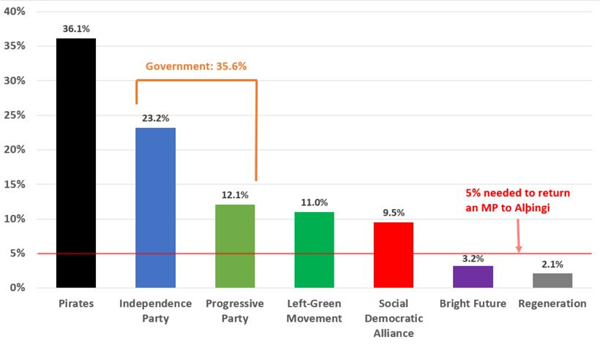
If an election does in indeed go ahead, Icelandic politics will be on a knife edge. Last Friday Gallup published the results of its latest poll and it shows that the leading political force in Iceland is the Pirate Party.

As the chart clearly shows, not only is the Pirate Party way ahead of its nearest rival, but it’s also polling just ahead of the combined Independence Party/Progressive Party coalition government – and this was the position before the Panama leaks controversy.

iceland-poll

For a country that relies on coalition governments this is a pretty big deal and for the local Pirate Party the achievement is nothing less than astonishing. In 2013 (and after just a few months of existence) the party achieved 5.1% of the vote and entered national government with three Members of Parliament.

It is now looking at the possibility of a much bigger prize with Pirate MP and spokesperson Birgitta Jónsdóttir noting that the party is prepared.

“In these strange times anything is possible,” she says.

“It’s a really liquid situation. But, of course, if it happens we are ready. We have been asked time and time again since we scored so high in the polls. We are ready.”

Jónsdóttir says she feels that Sigmundur Davíð Gunnlaugsson won’t step down and during a live TV broadcast yesterday he confirmed as much, stating that the Panama Papers contained “nothing new” about his and his wife’s business affairs.

Nevertheless, this storm is far from over. With the revelation that the Prime Minister’s finance minister and interior minister also had stakes in offshore companies, thousands of people protested outside Iceland’s Parliament last evening calling for the government to step down.

Only time will tell how this situation will play out, but the prospect of a Pirate-led coalition government is both intriguing and unprecedented.

Update: Prime Minister of Iceland Sigmundur Davíð Gunnlaugsson resigned.

Source: TF, for the latest info on copyright, file-sharing, torrent sites and ANONYMOUS VPN services.


Source: TorrentFreak