How British Scientists Got Inside North Korea to Study a Volcano

How British Scientists Got Inside North Korea to Study a Volcano

For weeks at a time in 2011, British and American researchers have gone to the Democratic People’s Republic of Korea, as North Korea is formally known, to collect rock samples and deploy seismometers—some even in the homes of North Korean villagers. The post How British Scientists Got Inside North Korea to Study a Volcano appeared first on WIRED.
Source: Wired.com Top Stories

MPAA Wants ISPs to Disconnect Persistent Pirates

pirate-runningIn recent weeks, many groups and individuals have voiced their opinions about the future of the DMCA, responding to a U.S. Copyright Office consultation.

This includes the MPAA, which acts on behalf of the major Hollywood studios. In a 71-page submission the group outlines many problems with the current law, asking for drastic reforms.

Ideally, the group would like search engines to enforce a “stay down” policy ensuring that content can’t reappear under different URLs. In addition, it would like registrars to suspend domain names of pirate sites, such as The Pirate Bay.

Another point of concern for the movie industry group is that of “repeat infringers,” people who frequently share pirated content. This applies to users of web services such as Facebook and YouTube, but also ISPs.

“The requirement that service providers terminate repeat infringers is critical,” MPAA writes in its submission.

The MPAA points out that the percentage of persistent pirates is relatively low compared to all Internet users who ever have committed copyright infringement online, but that they do pose a significant threat.

“The serial infringers, however, account for a disproportionate share of the overall prevalence of infringing content: They upload and download infringing copies much more heavily than those who do so once or twice; and they keep infringing content online and available for others to stream or download illegally for much longer than do other users.”

In the U.S. it is currently rare for ISPs to disconnect persistent pirates, with many arguing that only a court can decide if someone can be stripped from such an essential service as Internet access.

However, citing several recent legal cases, including the Cox lawsuit, the movie studios argue that ISPs should terminate the accounts of persistent pirates even if there’s no court order requiring them to do so.

According to the MPAA Internet providers “must terminate users who repeatedly and blatantly infringe copyright, regardless of whether there has been a judicial determination that the user is liable for copyright infringement.”

To accomplish this goal service providers should keep track of DMCA notices so they can identify repeat infringers and take appropriate action in response.

“The challenge now will be to have courts consistently enforce these rules against noncompliant services. Courts should also make it clear that an effective and compliant policy must not allow terminated users simply to create new accounts on the same service,” they write.

The Hollywood group’s calls are quite different from the voluntary agreement it currently has with ISPs. Under the Copyright Alert System ISPs are required to forward up to six notices per user account, but permanent Internet connections are not part of the deal.

Needless to say, ISPs are not going to be happy with the demands. In their submission to the Copyright Office they stressed that their subscribers shouldn’t lose Internet access based solely on copyright holder complaints.

With the many conflicting positions we reported on in recent weeks, it’s going to be very hard for the Copyright Office to come up with a plan that will suit everyone. In any case, we can look forward to some heated debates.

Source: TF, for the latest info on copyright, file-sharing, torrent sites and ANONYMOUS VPN services.


Source: TorrentFreak

Sky Subscribers Hit With New Wave of Piracy Notices

skyGoldenEye International are one of the small handful of companies engaged in so-called “copyright troll” activities in the UK.

Unlike thousands of other companies who try to have infringing content removed from the Internet, Golden Eye simply leaves it there while monitoring those who dare to download and share it.

For several years the company has been targeting subscribers in the UK and has recently sent out a new wave of threat letters. TorrentFreak has been in touch with many letter recipients, all of them customers of UK Internet service provider Sky.

The demands all relate to the alleged downloading and sharing of various pornographic movie titles owned by Ben Dover Productions, Immoral Productions, Third World Media, Echo Alpha and Harmony Films.

The High Court order through which GoldenEye (GEIL) obtained the users’ personal details is dated August 2015 but in some cases the alleged offenses date back to 2014 which in many cases makes it difficult to identify who might have been responsible.

Indeed, this is a problem faced by several letter recipients interviewed by TorrentFreak. While a minority accept that GEIL’s allegations are true, others are vigorously denying them.

Several insist that due to the number of people who have free access to their home connections it’s all but impossible to know who the infringer was back in 2014/2015, if there even was one.

But perhaps more worrying is what happens when people choose to engage Golden Eye themselves.

“In order to elicit a speedy response we recommend email as the most efficient communication,” GoldenEye says in its threat letter.

While email is indeed efficient, convenient and cheap for GoldenEye (a company obviously keen to keep its costs down), exchanges seen by TorrentFreak indicate a complete unwillingness for them to accept what they are being told.

In some instances letter recipients tell GoldenEye that not only did they not download or share anything illegally, but they haven’t allowed anyone else to do so either. The company effectively ignores these protestations and insists that its evidence was assessed by independent experts.

Interestingly, however, the reportedly independent experts are Tobias Fieser and Patrick Paige, men that are up to their necks in similar trolling activities in other parts of the world, with the latter previously being described in less than favorable terms.

Of course, no evidence has been actually tested by the court but most people corresponding with GEIL don’t know that. It’s worth noting that even if the evidence had been tested and it was guaranteed accurate, GEIL only have the bill payer’s name and if he or she didn’t do it, GEIL have a problem.

“It’s important to understand that the copyright owner can only take action against the person who actually committed the infringement. This may not be you,” the UK government told letter recipients in advice last week.

Worryingly, TorrentFreak has seen other correspondence that indicates that once letter recipients engage in discussion with GoldenEye via email, the porn outfit uses the opportunity to obtain more information, information that it did not have in the first instance. This is often known as a ‘fishing expedition’ and copyright trolls love them.

For example, some people have informed GEIL that they have left their router insecured so that friends and family can easily access the Internet when they visit. GEIL then want to know the names and addresses of these people so they can be pursued. Recipients are under no obligation to help with these inquiries but because of the legal threats, some feel obliged to comply.

Furthermore, others who have mentioned having an unsecured WiFi have been met with questions about the make and model of their router. Quite why GoldenEye need this information is uncertain but it’s almost certain that any information provided will somehow be used against the recipient.

The common theme throughout, however, is that whatever people tell GoldenEye in an email, the company either ignores or has a canned response for. The company sends PDF files back to people who email them with a defense and these are all template responses going over the same things time and again. It is clear that people aren’t being treated as individuals and that the process is being automated wherever possible.

With all this in mind people should consider whether email really is the best way to handle a claim from GoldenEye International. Granted, responses from the company are often quite quick, but this encourages people to respond quickly too, often without adequate consideration before doing so.

Resources: Speculative Invoicing Handbook, How to Deal with a File-Sharing Threat, hire a lawyer.

Source: TF, for the latest info on copyright, file-sharing, torrent sites and ANONYMOUS VPN services.


Source: TorrentFreak

Harry Potter Publisher Goes on a Bizarre Anti-Piracy Rampage

harryThe issue of removing infringing content and links from the Internet is perhaps the hottest topic in copyright today, with a U.S. Copyright Office consultation generating opinions from stakeholders of all kinds.

The aim of the consultation is to measure whether the DMCA is fit for purpose or whether it needs to be tweaked to handle an Internet that has developed massively in the past twenty years. Generally speaking, copyright holders want the DMCA tightened up dramatically, with many calling for regime that would see pirate content being taken down and remaining down forever.

While in some respects its easy to have sympathy with that stance, copyright holders can’t be trusted to get it right all of the time. In fact, sometimes mistakes are made that are so absurd that they deserve highlighting in public.

HarperCollins, Random House, Simon and Schuster, Reed Elsevier, Scholastic and J.K.Rowling’s Pottermore are some of the most recognizable publishers in the world and like many in their position, all have a bit of a piracy problem. Every year through their anti-piracy partners they send millions of takedown notices directly to ‘pirate’ sites and to Google, who are expected to take down content on demand.

It’s fortunate that Google does not do so without due consideration. It’s also fortunate that there’s no takedown-and-staydown system in place.

Pottermore is a digital publishing and e-commerce platform from J.K. Rowling, the author of the world famous Harry Potter series. Through anti-piracy company Digimarc the company has sent more than 260,000 takedown notices to Google with the majority raising few alarm bells. Recently, however, something appears to have gone terribly wrong.

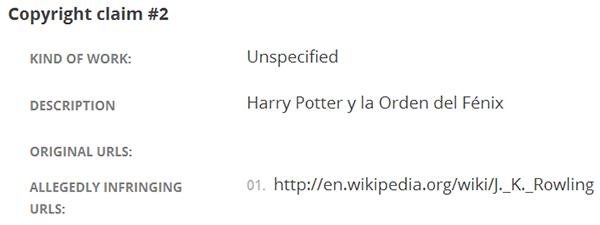
On March 8, Pottermore sent a notice to Google complaining that several sites were infringing on the rights of, among other things, Harry Potter and the Order of the Phoenix. Inexplicably, one of those complaints was leveled at J.K. Rowling’s own page on Wikipedia. The same mistake was made again on April 1.

potter1

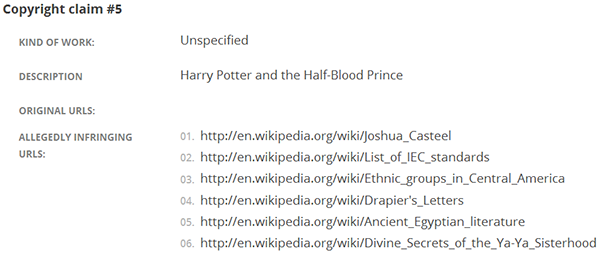
Fortunately Google refused to remove the page but Pottermore were undeterred and later that day sent an even worse notice that targeted a further 20 Wikipedia pages.

In addition to targeting several pages dedicated to Harry Potter movies, soundtracks and videos games, the notice casts its net far and wide with demands to remove pages detailing ancient Egyptian literature, ethnic groups in Central America, the attacks of 9-11, IEC standards, U.S. soldier Joshua Casteel and the NATO phonetic alphabet.

potter2

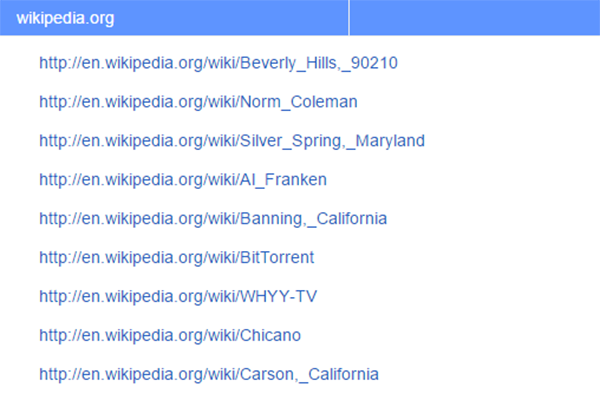
But Pottermore aren’t the only ones contributing to this Wikipedia mess. In early March, HarperCollins sent notices to Google, again through Digimarc, aiming to protect its own content. Instead, however, the company put its name to a whole bunch of bogus takedowns.

Instead of protecting the book ‘The Longest Trip Home’, the publisher tried to takedown the Wikipedia pages for Beverley Hills 90210 and Silver Spring, Maryland. Shortly after another notice targeted Wikipedia pages on the topics of BitTorrent, Carson in California, and the identity of Mexican Americans.

harper1

We won’t detail every single request here but there are dozen of bogus claims against Wikipedia, all of which Google (fortunately) denied. Those interested can find them in Google’s report where dozens are listed as rejected..

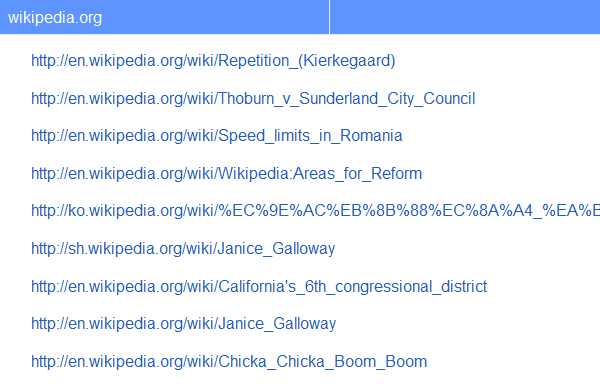
Simon and Schuster don’t have much to brag about either. In an effort to protect a handful of books they also targeted Wikipedia on dozens of occasions. With no apparent checking mechanism in place we can see the kinds of abuses shown below.

Poor Janice Galloway is actually a Simon and Schuster author, yet they want her Wikipedia page removed. Heaven knows what copyright crimes the speed limits in Romania have committed.

sas1

Finally, a couple of choice takedowns, the first from Reed Elsevier. In an effort to protect Mandell, Douglas, and Bennett’s Principles and Practice of Infectious Diseases, the publisher attempted to takedown the Wikipedia page detailing Mega, the file-hosting site previously associated with Kim Dotcom.

And Random House must have a real grudge against deceased U.S. writer Gore Vidal. On several occasions the company ordered Google to remove his Wikipedia page and links to his books, despite them being his publisher.

Takedown and staydown? Perhaps copyright holders want to think this through…..

The full catalog of Wikipedia takedown abuses can be found here.

Source: TF, for the latest info on copyright, file-sharing, torrent sites and ANONYMOUS VPN services.


Source: TorrentFreak

Paramount: We Own The Klingon Language

klingonEarlier this year Paramount Pictures and CBS Studios filed a lawsuit against the makers of the Star Trek inspired fan film, accusing them of copyright infringement.
The dispute centers around the well-received short film Star Trek: Prelude to Axanar and the planned follow-up feature film Anaxar.

Among other things, the Star Trek rightsholders claim ownership over various Star Trek related settings, characters, species, clothing, colors, shapes, words, short phrases and even the Klingon language.

Axanar productions and Alec Peters, the makers of the fan-spinoff, responded to several of the allegations last month arguing that several of the allegedly “infringing elements” are not protected by copyright at all.

They argued that the Klingon language is not copyrightable because it’s not more than an idea or a system. They therefore asked the court to dismiss or strike the copyright claims in question.

However, Paramount and CBS disagree (bIlughbe’*). In their reply the rightsholders call the argument absurd and among other things, they point out that the language system is not very useful if there are no real Klingons to communicate with.

“This argument is absurd, since a language is only useful if it can be used to communicate with people, and there are no Klingons with whom to communicate,” they write (full filing: pdf).

“Defendants’ use of the Klingon language in their works is simply further evidence of their infringement of Plaintiffs’ characters, since speaking this fictitious language is an aspect of their characters.”

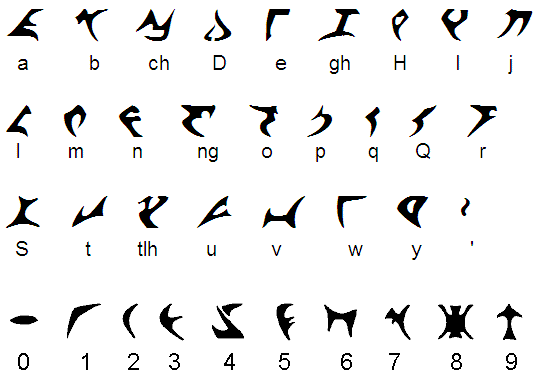
Klingon alphabet (image: wiki)

klingonalpha

In any case, the court should not rule on the matter prematurely, the rightsholders note. The question to what degree various elements are copyright infringing should be decided in future hearings where the issues can be properly addressed.

The same applies to other elements, including spaceships. Axanar productions argues that these general concepts can’t be copyrighted, but Paramount and CBS point out that their specific expression of Klingon warships is.

Klingon ships

klingonships

“Plaintiffs have not merely alleged that the general concepts of a ‘spaceship’ or a ‘spacedock’ have been appropriated – the Complaint’s allegations show that Defendants have misappropriated the expression of these concepts,” the movie studios inform the court.

Citing relevant case law, they argue that Star Trek starships deserve the same protection as the Batmobile.

“Even assuming that Defendants are properly dissecting the elements of the Star Trek Copyrighted Works (and they are not), courts have held that vehicles like the Batmobile are copyrightable as characters, and therefore, specific Star Trek starships are also copyrightable.”

Summing up, Paramount and CBS argue that the infringing status of the various elements should be considered in substantial similarity analysis during the lawsuit. They therefore ask the court to deny Axanar’s motion to dismiss or strike their claims.

*bIlughbe’ means you are wrong, in Klingon

Source: TF, for the latest info on copyright, file-sharing, torrent sites and ANONYMOUS VPN services.


Source: TorrentFreak